
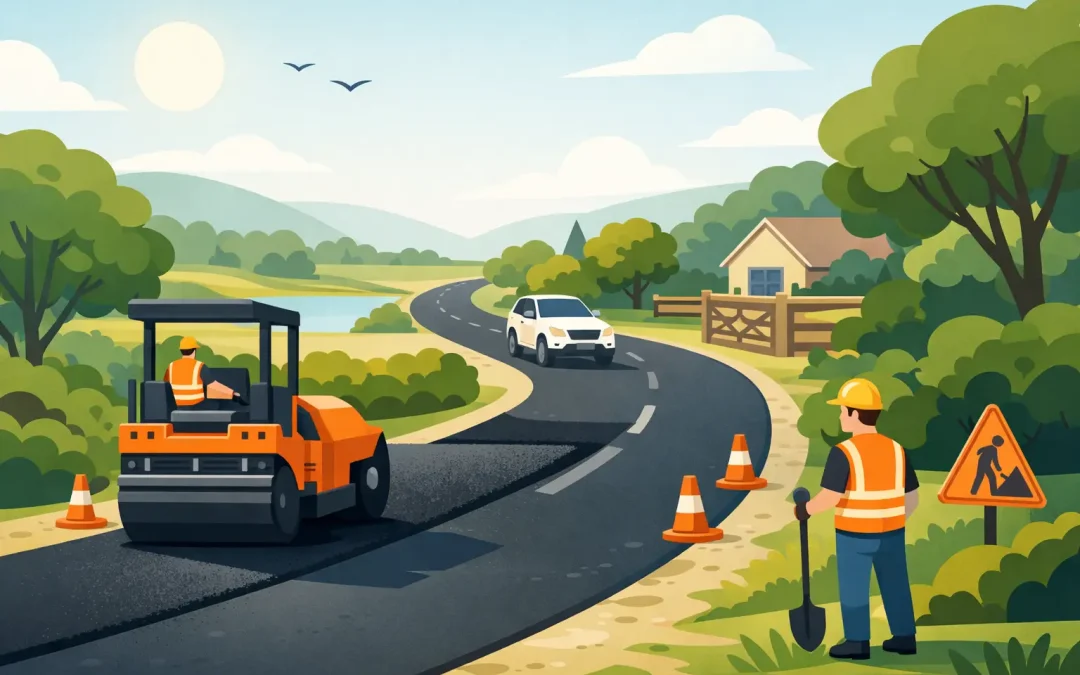
A private lane rarely fails all at once. It starts with loose stone at the edge, shallow puddles after rain and a few potholes where vehicles brake or turn. Left alone, water works beneath the surface, traffic breaks up the weakened areas and access becomes harder for residents, visitors, deliveries and emergency vehicles. Proper private road resurfacing deals with the cause as well as the visible damage.
For an estate road, shared driveway, farm lane or commercial access route, the right scope depends on what sits below the surface. A fresh layer of tarmac can be a sensible repair where the base remains sound. Where the road has sunk, holds water or repeatedly breaks up, the construction beneath it may need rebuilding first. This is where a practical site assessment saves money being spent twice.
Start with the condition of the road
Before choosing a finish, inspect how and where the road is failing. Potholes in isolated places may point to localised damage. Widespread cracking, uneven levels and rutting usually suggest a larger issue with the sub-base, drainage or both. The surface is only the final wearing course, so it cannot reliably hide movement below.
A site survey should consider the road’s length and width, traffic levels, turning areas, gradients and access for plant and lorries. A lane used by family cars has very different requirements from one carrying delivery vehicles, refuse lorries, horseboxes, agricultural machinery or construction traffic. Heavier loads demand a stronger foundation and suitable edge restraint to stop the new surface spreading or crumbling at the sides.
It is also worth identifying buried services, existing gullies, manhole covers, gates and drainage runs before work begins. These details affect levels, excavation depth and the practical order of the job. On rural sites, protecting verges, ditches, trees and nearby fields may be just as important as the road itself.
Drainage comes before private road resurfacing
Water is one of the main reasons private roads deteriorate. If rainfall cannot run off the surface or escape from the ground below, it weakens the sub-base. In winter, standing water can freeze and expand. In warmer months, traffic pushes into the softened ground, creating ruts and potholes.
A road should have enough fall to guide water towards suitable drainage points without making access uncomfortable or unsafe. Depending on the site, this may involve re-forming the road camber, clearing and repairing existing gullies, installing channel drainage or connecting drainage runs to a suitable outfall. On country lanes, ditch clearance and correctly formed grips can be part of the solution.
Drainage work must be planned carefully. Water cannot simply be directed towards a neighbour’s land, a building or an unsuitable boundary. Where soakaways, drainage fields or connections are needed, the ground conditions and available discharge route need proper consideration. In many cases, resurfacing and drainage should be carried out as one coordinated project rather than as separate jobs.
Decide whether to overlay or rebuild
There are two broad approaches to resurfacing. The first is an overlay, where a new surface is laid over a stable existing road after local repairs and preparation. The second is reconstruction, where failed material is excavated and replaced with a properly compacted foundation and new surface layers.
When an overlay can work
An overlay may suit a road that is generally level, well drained and structurally sound but looking worn, thin or patchy. The existing surface is repaired, loose material is removed and the road is cleaned and prepared so the new layer bonds correctly. Levels around gateways, drainage covers and thresholds must be checked, as adding material can reduce clearance or direct water towards a property if handled poorly.
Overlaying is often quicker and less disruptive than full reconstruction, but it is not a cure for serious movement. If the road is already sinking at the edges or breaking up across large areas, a new layer may only follow those defects within a short time.
When reconstruction is the better investment
Full reconstruction is usually needed where there are deep potholes, soft ground, failed edges, recurring standing water or extensive cracking. The damaged road is excavated to the required depth, unstable material is removed and the formation is prepared. A geotextile membrane may be used where ground needs separating from the stone foundation, followed by correctly graded aggregate laid and compacted in layers.
The finished road can then receive a base course and wearing course, or another specified finish. This work is more involved, but it gives the surface a stable platform. For private roads with regular traffic or long-term access needs, rebuilding the failed sections properly is often the more economical decision over time.
Choosing the right surface finish
The best finish depends on the road’s purpose, appearance, maintenance expectations and budget. It also depends on the condition of the base. No finish will perform well if the construction below it has not been addressed.
Tarmac is a popular choice for private lanes, shared drives and car parks because it provides a smooth, practical surface for everyday vehicles. It is particularly suitable where easy sweeping, walking, cycling and wheelchair access matter. A properly laid tarmac surface also works well around entrances, parking bays and tighter turning areas.
Hot tar and chippings provide a more traditional, textured appearance that suits rural properties, private estates and long access roads. The finish offers good grip and can blend well with country surroundings. Loose chippings are expected during the initial period, so the road should be used with care until it has settled and been swept as required.
Loose aggregate can be appropriate for lower-traffic farm tracks and informal rural routes, especially where a bound surface is not required. However, it needs regular grading and topping up, and it can migrate at slopes, corners and entrances. It is rarely the best answer for a route that is already suffering from water damage or heavy vehicle use.
For some sites, the most practical solution is a combination. A tarmac entrance and turning area may handle concentrated traffic, while a tar and chip finish continues along the private lane. Matching the finish to each part of the route can control cost without compromising the areas that take the greatest strain.
Edges, entrances and turning areas matter
Road edges are often the first areas to fail. Cars pull over, lorry wheels run close to the verge and water enters from the side. Without sufficient support, the edge fractures and the damage works back into the carriageway.
Clear edge definition, suitable stone support and well-managed verges help protect the new work. Gateways need particular attention because braking, turning and vehicle weight are concentrated in a small area. The same applies to bin collection points, delivery bays, stable yards and junctions with public roads.
If the road meets a public highway, levels and drainage must be managed so that material, water and loose stone are not carried onto the carriageway. Access arrangements, visibility and any necessary permissions should be checked before work is programmed.
Plan around access and shared responsibility
Private road work is often carried out where people still need to get home, reach a business or access land. A good programme sets out how vehicles, pedestrians, deliveries and emergency access will be managed while excavation, drainage and surfacing take place. On a shared lane, early communication helps prevent avoidable problems.
Responsibility for a private road is not always straightforward. It may sit with one owner, several households, a management company, a landlord or an estate. Before committing to major work, establish who is responsible for maintenance, whether there are rights of way and how costs will be agreed. A clear written scope is especially useful where several parties are contributing.
The quote should distinguish between local repairs and full reconstruction, and should state the proposed drainage work, excavation depth, aggregate build-up, surface material and treatment of edges. This makes it easier to compare like for like. A low price for a thin overlay is not the same as a price for removing failed ground and building a new road foundation.
What a well-managed project looks like
The quality of private road resurfacing is decided long before the final roller passes over the surface. It comes from survey work, drainage planning, correct excavation, suitable materials and proper compaction at every stage. Weather also matters. Bound surfaces need suitable conditions for laying, while wet ground can affect excavation and sub-base preparation.
At Heath Bridge Construction, road and driveway works can be planned alongside drainage, groundworks, vegetation clearance and entrance improvements where the site requires it. Using one experienced contractor for interconnected works helps keep levels, drainage routes and finished surfaces coordinated.
A sound private road should make access feel ordinary again: no avoiding potholes, no standing water at the gate and no concern that the next heavy vehicle will cause fresh damage. When the ground beneath the surface is dealt with properly, the finished road has a far better chance of staying that way.